The FDA Breakthrough Therapy Designation: A Primer


Picture1

By Peter Martin, M.D.

The Breakthrough Therapy Designation was introduced as part of the 2012 Food and Drug Administration Safety and Innovation Act and is designed to expedite the development of new treatments for serious conditions like lymphoma. If preliminary evidence from clinical trials demonstrates that a new drug represents a significant improvement over currently available therapies, the drug developer (also called the Sponsor) may request a Breakthrough Therapy Designation.

If the FDA agrees with the Sponsor and grants the designation, they will subsequently commit to providing additional resources to the development and review process.  Practically this means  more frequent meetings and communications with senior FDA officials, and aid in designing more efficient clinical trials. Although the Breakthrough Therapy Designation does not make a new drug available, early experience with the program suggests that it can shave years off of the typical development process.

Since 2012, the Sponsors of 342 treatments have applied for this status, with 111 receiving the designation. Of the treatments that have received the designation 42 have received full approval. In 2016 pembrolizumab received the designation for the treatment of patients with relapsed or refractory classical Hodgkin lymphoma and venetoclax received it in combination with rituximab to treat patients with relapsed/refractory chronic lymphocytic leukemia. Previously nivolumab, idelalisib, ofatumumab, obintuzumab, and ibrutinib all received the Breakthrough Therapy Designation for different lymphoma indications.

Despite the success of the program there are several points to keep in mind. The FDA’s definition of “breakthrough” is very different from its interpretation by lay persons and the media. The FDA’s definition refers to a drug that in the early stages of development has shown the potential for an improvement in patient care. It is not a guarantee of the approval or long-term success of the treatment.

As the FDA and Sponsors gain additional experience with the program we are likely to see some changes, including the number of applications and the cost of requesting a Breakthrough Therapy Designation. We are also likely to witness some unintended consequences, including investments by venture capitalists and opaque marketing strategies. When in doubt a patient should consult a physician about the usefulness of any treatment.

At the Weill Cornell Lymphoma Program, we are interested in any program that helps make promising new therapies available to patients as quickly as possible, and so we continue to follow this and other related programs closely. In the next post in the series we will discuss the Fast Track Designation.

Previous Entries in the Primer Series

The FDA Approval Process

Ask the Doctor: Lisa Roth, MD on Lymphoma in Adolescents and Young Adults

Lisa Roth, MD
Lisa Roth, MD

Every year nearly 70,000 adolescents and young adults (AYAs) are diagnosed with cancer in the United States. Of these, lymphoma is the most common. Teenagers and young adults with lymphoma have different needs than other cancer patients. Treatment can affect your education, career, fertility, and independence, which can be challenging for both patients and their families. Because of this, adolescents and young adults with lymphoma often feel lost – not quite fitting in at pediatric or adult treatment centers.

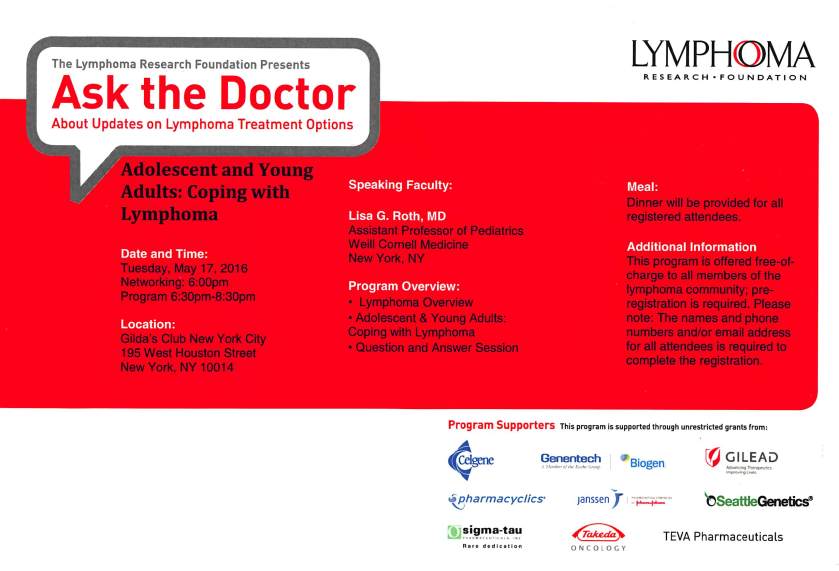
On May 17th at 6pm, Dr. Lisa Roth, Director of the Adolescent and Young Adult Lymphoma Program at Weill Cornell will present on the challenges faced by these patients. Her talk titled, “Updates on Lymphoma and Treatment Options for Adolescents and Young Adults”, is part of the Lymphoma Research Foundation’s, ‘Ask the Doctor Survivorship Program’.  This event will take place at Gilda’s Club, New York City.

Dr. Roth will answer questions and discuss the following topics:

  • How lymphoma is different for adolescents and young adults
  • Navigating treatment options
  • Understanding fertility preservation
  • Coping with side effects
  • Life after lymphoma treatment

This program is free-of-charge and dinner will be provided. Pre-registration is required. Full details are below:

Three Easy Ways to Register

Call: 800-500-9976
Email:  mspellman@lymphoma.org
Web: Click here

Roth YA Talk_Page_1


The FDA Approval Process: A Primer

Peter Martin, M.D.

By Peter Martin, M.D.

In addition to providing the best possible care for people with lymphoma, one of our primary goals in the Weill Cornell Lymphoma Program is to help develop better treatments. To keep track of these approvals we have created the Lymphoma Therapy Approval Timeline page on our blog. The timelines lists all of the new Breakthrough Designations, and approvals generated by the FDA for therapies related to the treatment of lymphoma. More in-depth information about these approvals can be found  our blog.

So far, 2016 has been an eventful year, with six drugs receiving an updated approval status or Breakthrough Therapy Designation for the treatment of lymphoma. At the same time, recent circumstances have led to the closure of at least seven clinical trials evaluating the role of idelalisib. In the face of all this activity, it is clear that we are keeping the FDA busy. People in my clinic ask me almost every day, “Why does it take the FDA so long to approve promising new drugs?” To help answer this question I will write a series of blog posts summarizing the drug development process. An in-depth explanation of the process can be found on the FDA website.

Today, in the first post of the series, I thought it would be interesting to address whether the FDA is a bureaucratic wall standing between patients and potentially lifesaving cancer therapy, whether the FDA has become too lax in its approval process, resulting in approval of dangerous drugs or labels that are too broad, or whether it gets the balance just right.

In 2014 Yale University researchers published a study that sought to characterize how new treatments were approved by the FDA between 2005 and 2012. Of the 188 new treatments included in the study the largest group were cancer treatments at 41 (19.9%). Compared to other indications, cancer treatments were more frequently approved through less time consuming non-randomized, non-blinded studies, and accelerated approval programs. Instead of using standard clinical outcomes, nearly all of these trials measured surrogate end points like reduced tumor size or decreased biomarker levels. These endpoints can be reached in shorter periods of time than clinical outcomes like overall survival. The study authors noted that while treatments for other indications generally relied on 3 trials, “Most therapeutic agents approved for cancer indications were approved on the basis of a single trial.”

Some of these recent approvals likely reflect that fact that we are in the midst of a scientific revolution, with an explosion of new drugs that are clearly superior to older therapies becoming available at an unprecedented rate. But it is also clear that the FDA is aware that people with cancer face unique circumstances and are willing to move forward with new drugs at a faster rate. If you have any specific questions or experiences that you’d like us to cover in this series of posts, let me know and I’ll do my best to address them. Stay tuned!