
Brentuximab Vedotin is Well Tolerated as Second Line Therapy for Hodgkin Lymphoma

Picture1By Peter Martin, MD

On December 9, 2014 I wrote a brief post describing preliminary results from a phase II study of brentuximab vedotin as second-line therapy for Hodgkin lymphoma. The investigator-initiated study was performed jointly at City of Hope and Weill Cornell Medical College, highlighting a new era of collaboration between researchers working to improve the outcomes of people with lymphoma. The results of that study have now been published in the peer-reviewed journal Biology of Blood and Marrow Transplantation.

The purpose of the study was to evaluate the efficacy of brentuximab vedotin as second-line therapy in Hodgkin lymphoma (i.e., the lymphoma was not cured by first-line chemotherapy). Of the 37 study participants, almost half were able to proceed to potentially curative stem cell transplantation with brentuximab vedotin alone; i.e., no chemotherapy. Interestingly, all of the 13 patients that achieved a complete response with brentuximab vedotin did so within just 2 cycles (3 weeks).

This study suggests that brentuximab vedotin is efficacious in the second-line, pre-transplant setting, and that some patients may be spared cytotoxic chemotherapy prior to transplant. Moreover, responses seem to occur quickly in those people most likely to benefit, and there appears to be little rationale for continuing the same dose of brentuximab vedotin beyond 2 cycles in patients that have not achieved a complete response. Despite the clear activity of brentuximab vedotin in this setting, we do not advocate its use outside the context of a clinical trial until additional studies and longer follow up has been reported. Future studies will focus on combining brentuximab vedotin with other targeted agents with the intention of improving outcomes even more.

For more information about brentuximab vedotin look to this blog for further updates. If you are interested in Hodgkin lymphoma related clinical trials please visit our clinical trials listings.
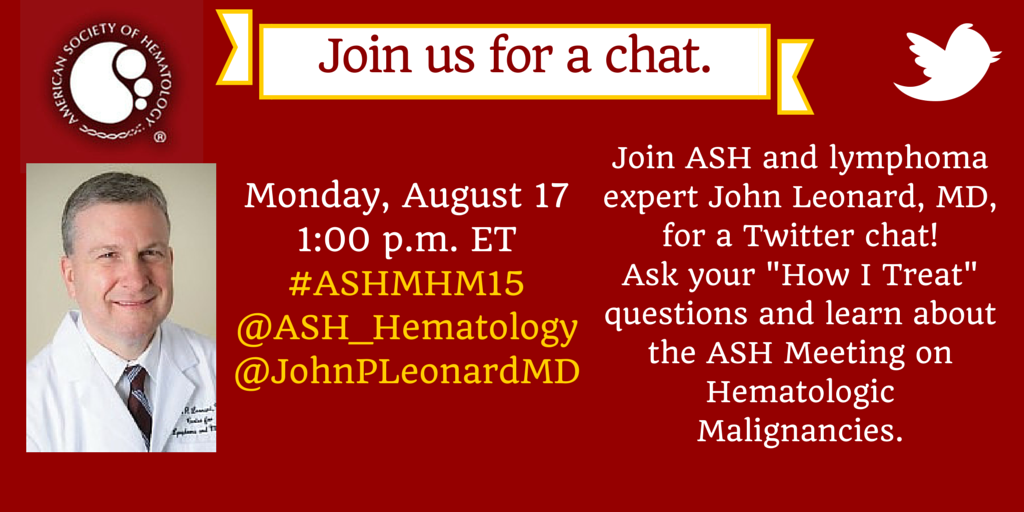
Join Dr. John Leonard for a Twitter Chat hosted by the American Society of Hematology

Leonard Twitter Chat

New Clinical Trial: Study to Determine the Safety, Pharmacokinetics, & Efficacy of Single Agent CC-122 with Rituximab/Ibrutinib in Patients with Relapsed & Refractory CLL/SLL

The Weill Cornell Lymphoma Program has recently opened a new clinical trial for men and women with relapsed or refractory CLL/SLL. The study sponsor is the Celegene Corporation, and the principal investigator at Weill Cornell is Richard Furman M.D.. For more information about the study, please call Amelyn Rodgriguez, RN at (212) 746-1362 or e-mail Amelyn at amr2017@med.cornell.edu.

Key Eligibility

  • Men and women age 18 to 79.
  • Diagnosis of CLL/SLL.
  • Must meet the criteria for relapsed and/or refractory disease.
  • Detailed eligibility reviewed when you contact the study team.

Study Summary

This clinical trial is for men and women with relapsed/refractory CLL/SLL.

Subjects on this study will receive the study drug, CC-122, in combination with rituximab or ibrutinib, or as a single agent. CC-122 is an analog of thalidomide and has multiple activities in CLL, including immune modulation (activation of cells in the immune system) and anti-proliferative activity. CC-122 has also been shown to have a tolerable safety profile with some preliminary signs of efficacy with early human experience. Rituximab is a monoclonal antibody directed against a molecule present on the surface of normal B lymphocytes and CLL cells. Ibrutinib is a BTK inhibitor that has received accelerated approval in the United States for patients with CLL who have received at least one prior therapy. This study will provide more information about the efficacy and safety of CC-122 both as a single agent and in combination with rituximab or ibrutinib in subjects with CLL/SLL.

All subjects will receive CC-122 continuously throughout the study as long as they are responding to therapy and not experiencing unacceptable side effects. Some subjects will receive ibrutinib which will be taken continuously throughout the study. Both CC-122 and ibrutinib will be administered orally once daily. Other subjects will receive rituximab which will be administered intravenously on cycle 1 day 1 and 8, and on day 1 of cycle 3, 5, 7, 9, and 11. After discontinuing treatment, subjects will be contacted every 90 days for follow-up information until disease progression, withdrawal of consent, or loss to follow-up.

Subjects may receive up to forty dollars per visit for the reimbursement of travel expenses.