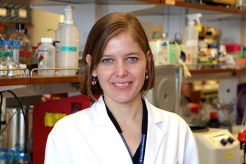
Splitting her time between the main Cornell campus in Ithaca and the Weill Cornell Medical campus in New York City, Dr. Kristy Richards has developed a unique plan to research new lymphoma treatments. Lymphoma is a common form of cancer in humans and also the most common form of cancer found in dogs. So as human oncologist, Dr. Richards thought that treatments for canine patients could lead to advances in the treatment of human lymphoma patients,
“Dog and human lymphoma patients share many biological similarities, as well as the unfortunate fact that rates of the disease are rising for both species. “We don’t know why this is,” Richards says. “It could be something in the environment, which both dogs and humans share. So in a way, dogs could be a canary in the coal mine.”
“Richards plans to test cutting-edge approaches such as immunotherapy, which harnesses the body’s natural defenses to fight off cancer cells, in dogs suffering from lymphoma. This September, she was awarded a supplement grant from the National Cancer Institute, in partnership with the Roswell Park Cancer Institute in Buffalo, to further explore canine immunotherapy with veterinary patients that come to the Cornell University Hospital for Animals.”
The full article can be read here. More information about Dr. Richards work and the practical benefits so far accrued for both two and four legged lymphoma patients can be found in the below video.
The enemy approaches. Scouts pick up the scent and send signals to the relay team. The troops are rallied and an attack is prepared, strategically aligned to the specific weaknesses of the foe.
So it is with the body’s immune system. The scouts are T-cells, which pick up the antigen ‘scent’ of foreign invaders and notify their B-cell brethren to shift forms into plasma cells and produce weapons – antibodies – to attack.
Most of the B-cells respond by rapidly producing plasma cells, but this first line of defense is often weak. Luckily, a select few form into a special forces unit: the germinal center. Germinal centers are balls of furiously dividing B-cells that are mutating in order to tailor their antibody genes to attack offending antigens. The result is a much more powerful immunological army, with high affinity antibodies that can fully get rid of the antigen.
Once the job is done, the special forces unit is disbanded, the rapid proliferation and mutations end, and the germinal center cells are reprogrammed into normal plasma cells.
Ari Melnick, M.D.
Exactly how this shape shifting process happens has been a mystery – until now. A team of researchers at Weill Cornell Medicine, led by Gebroe Family Professor of Hematology and Oncology Ari Melnick, M.D., has uncovered the mechanisms by which B-cells transform, and found that it requires a special cooperation between regulatory protein EZH2 and transcription protein BCL6.
“The transition from a resting mature B-cell to a germinal center B-cell is nothing short of astonishing, as these cells are radically different from each other and this dramatic change requires extensive epigenetic reprogramming, or loading completely different software into the B-cell hardware,” Melnick said.
The discovery is key to understanding how certain blood cancers, such as the fast-growing diffuse large B-cell lymphoma, form and evolve. And it may have an impact on a potential new therapy.
“The basic properties of germinal center B-cells is to proliferate and mutate. Hence, they are prone to becoming lymphomas if something stops them from unloading the germinal center software,” Melnick said.
Scientists have long debated which regulatory system was responsible for B-cell programming.
EZH2 is an enzyme that chemically modifies the regulatory backbone proteins that control our genomes. It drives germinal center formation by suppressing cell-cycle checkpoint genes, repressing genes involved in plasma cell differentiation, and possibly impairing DNA damage responses.
BCL6 is a master regulator protein that attaches to the genome at sites that are crucial for the development of germinal centers.
Both EZH2 and BCL6 are known to repress transcription, the first step of gene expression, in which a particular segment of DNA is copied into RNA (mRNA).
Wendy Beguelin, Ph.D.
In a study published August 8 in Cancer Cell, Melnick and first author Wendy Beguelin, Ph.D., show that neither alone is responsible – rather, the two form separate but nearby attachment points to the genome to capture a molecular machine called “BCOR complex” which then carries out the actual work of shutting down regions of the genome.
Just as the Air Force requires two officers to simultaneously punch in personal codes and insert and turn individual keys in order to launch dangerous missiles, the immune system seems to require two biochemical keys to shapeshift a friendly B-cell into a freakazoid germinal center B-cell capable of causing lymphomas.
“We show that the ‘missile’ that causes the final effect of controlling B-cell genes is the BCOR complex, which requires the EZH2 and BCL6 key to launch,” Melnick said. Lymphomas occur when these keys get “stuck” due to mutations or other influences.
“Although it may seem a subtle point it is actually quite profound,” Melnick added. “This is the first time it has been shown that such combinatorial repressive mechanisms exist between these kinds of regulatory proteins.”
The Melnick team also discovered the key missing link between EZH2 and BCL6: the CBX8 protein. It acts as a biochemical bridge by attaching to the histone mark placed by EZH2 and the BCOR protein that interacts with BCL6.
“It is the glue that makes the whole thing work,” Melnick said.
To stop out-of-control, lymphoma-generating germinal centers, the Melnick team suggests that disarming the biochemical “keys” could be key.
“If you hit both keys, then the missile silo goes dark and the germinal center B-cells fall apart,” Melnick said. “Either one alone is only partially effective; you have to disable both arms of the PRC1-BCOR tethering mechanism.”
This is possible by combining BCL6 and EZH2 inhibitors. EZH2 inhibitors are in clinical trials for patients with lymphomas at Weill Cornell and elsewhere, and BCL6 drugs have been developed by Dr. Melnick and colleagues and are not yet in human trials. The Melnick team showed that the EZH2-BCL6 drug combination synergistically suppressed human diffuse large B-cell lymphomas in pre-clinical studies.
“Although both EZH2 and BCL6 inhibitors inhibited tumor growth alone, the combination more potently and significantly suppressed lymphoma growth,” Melnick said. “In addition, the combination was not toxic to normal cells.”
The work was supported in part by grants from the National Institutes of Health, the National Cancer Institute, the American Society of Hematology, and the Leukemia and Lymphoma Society.
Diffuse large B-cell lymphoma (DLBCL) is the most common form of non-Hodgkin lymphoma in adults. While DLBCL is potentially curable, patients with relapsed or refractory DLBCL cannot be cured with chemotherapy due to the aggressive nature of their disease and their tumors lack of response to chemotherapy. Therefore treating this subset of DLBCL patients requires new treatment options. Recently researchers from Dr. Leandro Cerchietti’s lab published a paper on a potential new target for DLBCL.
DLBCL tumor cells grow because malignant cancer cells disturb cell processes like DNA methylation and histone acetylation that are two key parts of the “epigenomic” machinery. Researchers in Dr. Leandro Cerchietti’s lab have previously reported that inhibiting one of these epigenomic pathways by using DNA methyltransferase inhibitors (DNMTI), makes tumors more susceptible to chemotherapy treatments. His group hypothesized that inhibiting both epigenomic pathways by combining DNMTI with a histone deacetylase inhibitor (HDI) could be a potential treatment option for DLBCL patients that relapsed after chemotherapy or never responded to chemotherapy.
Leandro Cerchietti, MD
Researchers decided to evaluate the effectiveness of combining the HDI, vorinost with the DNMTI’s, azacitidine or decitabine in pre-clinical models to determine the feasibility of beginning phase I human trials. Researchers found no significant toxicity increase in initial laboratory and animal trials. In the ensuing trial 18 patients with a median of 3 prior therapies were treated with 4 different dose levels of azacitidine and vorinostat. The most common side effects were manageable and included hematological, gastrointestinal, and metabolic toxicities.
The clinical benefit to the combined epigenetic treatment was low as only one patient experienced a partial response. However, 2 of the 7 patients, who received chemotherapy after the study achieved a complete response, while 3 others patients derived a significant clinical benefit. This suggests that the proposed epigenetic combination could make tumors more susceptible to chemotherapy treatments.
Further research in pre-clinical models confirmed that DNMTI is the most important drugs in the combination to achieve chemosensitization, which makes tumors more susceptible to chemotherapy treatment. The data supports the strategy of using DNMTI in relapsed and refractory DLBCL patients to overcome disease resistance and improve their outcomes. This treatment could potentially be a new option for patients with relapsed or refractory DLBCL.



 New Developments in Lymphoma