Lymphoma Physicians Discuss Lenalidomide Plus Rituximab as Initial Mantle Cell Lymphoma Treatment

Recently Dr. John Leonard was interviewed by the Lymphoma Research Foundation and answered questions about the current state of treatment for patients with mantle cell lymphoma (MCL). Specifically, they discussed how results from the 2015, New England Journal of Medicine published study, “Lenalidomide plus Rituximab as Initial Treatment for Mantle Cell Lymphoma” has improved the treatment options for MCL patients. This multi-center phase 2 study showed that a combination therapy, lacking many of the typical debilitating effects of traditional cancer treatment could effectively manage MCL by inducing remissions in the vast majority of patients.

Dr. Leonard, the study’s senior author, described the potential impact of this research and how it could improve our understanding of MCL and treatment as follows,

“This research provides an additional option for patients with MCL and represents the first study of a non-chemotherapy approach that is generally of lower intensity than usual initial treatment. The fact that the majority of patients had durable disease control, with good quality of life, suggests that this approach may have value for some patients. Ongoing research will better assess the longer term outcomes with this approach, and how it either compares with or can be combined with other treatments. This study demonstrates the value of potentially using newer agents as part of initial treatment in MCL, rather than holding off until the disease recurs later.”

In April 2016 the study was nominated by the Clinical Research Forum as one of their Top 10 Clinical Research Achievement Awards of 2016. The 10 winning papers were chosen based on their degree of innovation from a pool of more than 40 nominations from 30 research and academic health centers nationwide.

In the video below you can watch the study’s lead author Dr. Jia Ruan describe the importance of her team’s findings.
Weill Cornell Lymphoma Program Study on Mantle Cell Lymphoma Has Received a Top 10 Clinical Research Forum Achievement Award from a National Clinical Research Organization

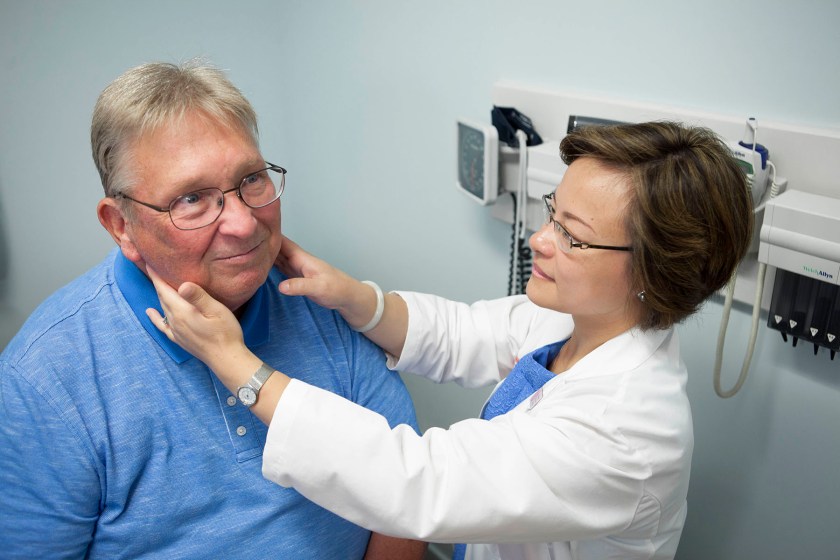
Dr. Jia Ruan examines study participant Russell Meyer. Photo credit: Carlos Rene Perez

Dr. Jia Ruan, lead author of the New England Journal of Medicine  study “Lenalidomide plus Rituximab as Initial Treatment for Mantle-Cell Lymphoma,” was in Washington on April 12 at the Clinical Research Forum fifth annual awards ceremony to receive the Top 10 Clinical Research Achievements Award.  She also presented the study at the opening plenary session during the 2016 Translational Science meeting.

The 10 winning papers were chosen based on their degree of innovation from a pool of more than 40 nominations from 30 research and academic health centers nationwide.

The multi-center phase 2 study showed that a combination therapy lacking many of the typical debilitating effects of traditional cancer treatment could effectively manage mantle cell lymphoma by inducing remissions in the vast majority of patients.

Mantle cell lymphoma (MCL) is a subtype of non-Hodgkin lymphoma that primarily affects elderly individuals. Initial treatment is not standardized and variable, but usually includes chemotherapy regimens that are generally not curative and may not be tolerated by all patients.

In this ongoing study, treatment with biologic combination of lenalidomide and rituximab led to high response rates and durable remissions in patients with previously untreated MCL, providing an effective alternative to conventional chemotherapy for a broad range of patients.

Thirty-eight patients have been treated on the study with induction and maintenance therapy. Among 36 evaluable patients, 92% responded to treatment, 64% of whom achieved complete response. Eighty-five percent of patients have no evidence of disease progression, and 97% remain alive at the two-year mark. The majority of patients reported a high quality of life as measured by quality-of-life instruments throughout treatment. The most common side effect were asymptomatic low white blood cell counts and transient inflammatory symptoms generally reversible with lenalidomide dose adjustment and supportive care.

“With this frontline treatment, we were able to achieve a very high quality and durable response rate without needing to use chemotherapy,” Ruan said. “It’s very meaningful for the patients who have always been told that their disease is without a cure.”

She thanked all of the patients who participated in the trial, as well as her Weill Cornell Medicine co-investigators: John Leonard M.D., Peter Martin M.D., Morton Coleman M.D., Richard Furman M.D., Paul Christos Dr.P.H. M.S., Orel Katz P.A., Jessica Katz P.A., and Amelyn Rodriguez R.N. Additional collaborators included Dr. Bijal Shah from Moffit Cancer Center, Drs. Steven Schuster and Jakub Svoboda from the University of Pennsylvania Abramson Cancer Center, and Dr. Sonali Smith from the University of Chicago Medical Center.


New Approach to Treating Aggressive B-cell Lymphomas

Leandro Cerchietti
Leandro Cerchietti, M.D.

In a study published in February 2016 in Blood, researchers from Leandro Cerchietti’s lab at Weill Cornell Medicine in collaboration with the University of Montreal identified a potential new strategy for the treatment of aggressive diffuse large B-cell lymphomas (DLBCL) called double and triple hit lymphomas.

What are double and triple hit lymphomas and why they are they so difficult to treat?

Double and triple hit lymphomas have chromosomal changes in two or three genes (MYC, BCL2, and/or BCL6) which encode for proteins that have a primary role in cell growth and contribute to the development of cancer. Chemotherapy does not work well to kill these types of lymphomas. Further, patients with double and triple hit lymphomas are often older and have difficulty tolerating aggressive chemotherapy. Therefore it is essential for new, targeted therapies to be developed that are less toxic for these patients.

What did researchers find?

The researchers found that the combination of an FDA-approved antiviral medication called ribavirin and a new targeted medication called an Hsp90 inhibitor work together to kill double and triple hit lymphomas in preclinical models. Ribavirin blocks the function of a protein called eIF4E. With the inhibition of Hsp90 and eIF4E, the proteins MYC, BCL2, and BCL6 are less effective in promoting growth of lymphoma cells. The addition of ribavirin also may prevent developing resistance to treatment with the Hsp90 inhibitor.

What do these findings mean for patients? 

The lymphoma group at Weill Cornell Medicine is developing a phase I clinical trial to determine the optimal dose of an Hsp90 inhibitor and ribavirin for patients with aggressive DLBCLs that do not respond or return after initial therapy. We will evaluate tumor and blood samples before and after treatment with this combination to confirm that it negatively impacts MYC, BCL2, and BCL6 as expected. This is a promising treatment strategy in these patients and expected to be much better tolerated than chemotherapy.

Stay tuned for future updates regarding treatments for double and triple hit lymphomas at Weill Cornell.