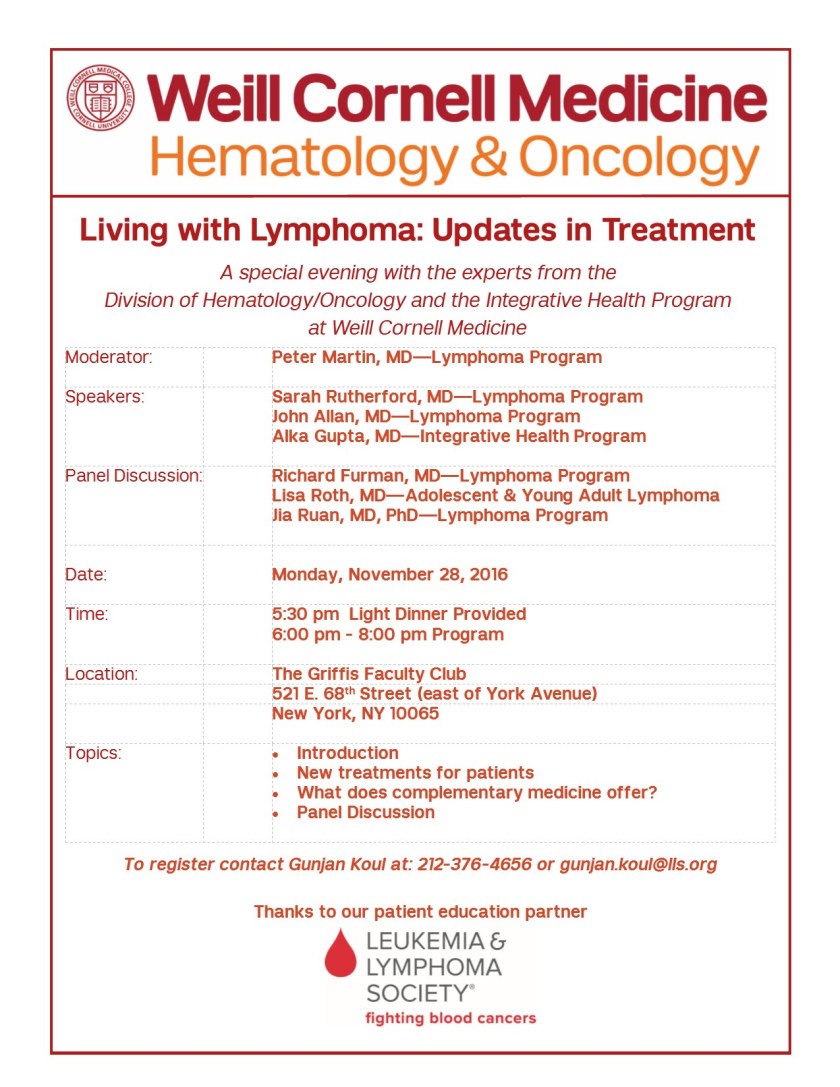
Join us for a special event as the Lymphoma Program faculty host a discussion on the latest updates in the treatment of lymphoma with our partners at the Leukemia & Lymphoma Society. Details are below. To attend the event you must register here with the LLS.
2016 has been another productive year for research in the Lymphoma Program at Weill Cornell Medicine. Listed below are the abstracts we were involved in whole or in part to be presented at this year’s 58th Annual Meeting of the American Society of Hematology (ASH).
Look to this space for more information about developments during the ASH meetings this December 3-6.
Dan Landau, M.D., Ph.D. recently sat down to speak with The Video Journal of Hematology Oncology about how technology with drive future advances in the treatment of CLL. Currently we understand that a malignant population such as a population of CLL cells in any patient, is actually not uniform but composed of multiple sub-populations, which continuously compete, evolve and create diversity. The therapeutic challenge is that in each patient, we are not dealing with one disease but with a collection of many diseases.
Therefore, it is not surprising that therapies can fail. With new genomic technologies, it is now possible to survey this genetic complexity for large cohorts of patients in order to understand the processes underlying the complexity. By taking an evolutionary perspective and combining it with genomic methods, we can infer the past history of disease and use this information to predict its future.
Dr Landau points out how today data science approaches are already being used to predict real world outcomes in advertising or on the stock market for example. However, data science approaches are not really being applied in cancer research. Further, he discusses non-genetic sources of diversity, such as epigenetics and spatial location. All of these layers of information need to be considered in order to understand the evolutionary process.
Finally, he discusses the idea of measuring clonal kinetics directly in patients, i.e. measuring the rate of growth of each clone with each therapy and come up with an optimized therapeutic approach through the use of algorithms; he considers this approach to be a radical extension of the precision medicine paradigm.

 New Developments in Lymphoma