
Brentuximab Vedotin is Well Tolerated as Second Line Therapy for Hodgkin Lymphoma

Picture1By Peter Martin, MD

On December 9, 2014 I wrote a brief post describing preliminary results from a phase II study of brentuximab vedotin as second-line therapy for Hodgkin lymphoma. The investigator-initiated study was performed jointly at City of Hope and Weill Cornell Medical College, highlighting a new era of collaboration between researchers working to improve the outcomes of people with lymphoma. The results of that study have now been published in the peer-reviewed journal Biology of Blood and Marrow Transplantation.

The purpose of the study was to evaluate the efficacy of brentuximab vedotin as second-line therapy in Hodgkin lymphoma (i.e., the lymphoma was not cured by first-line chemotherapy). Of the 37 study participants, almost half were able to proceed to potentially curative stem cell transplantation with brentuximab vedotin alone; i.e., no chemotherapy. Interestingly, all of the 13 patients that achieved a complete response with brentuximab vedotin did so within just 2 cycles (3 weeks).

This study suggests that brentuximab vedotin is efficacious in the second-line, pre-transplant setting, and that some patients may be spared cytotoxic chemotherapy prior to transplant. Moreover, responses seem to occur quickly in those people most likely to benefit, and there appears to be little rationale for continuing the same dose of brentuximab vedotin beyond 2 cycles in patients that have not achieved a complete response. Despite the clear activity of brentuximab vedotin in this setting, we do not advocate its use outside the context of a clinical trial until additional studies and longer follow up has been reported. Future studies will focus on combining brentuximab vedotin with other targeted agents with the intention of improving outcomes even more.

For more information about brentuximab vedotin look to this blog for further updates. If you are interested in Hodgkin lymphoma related clinical trials please visit our clinical trials listings.
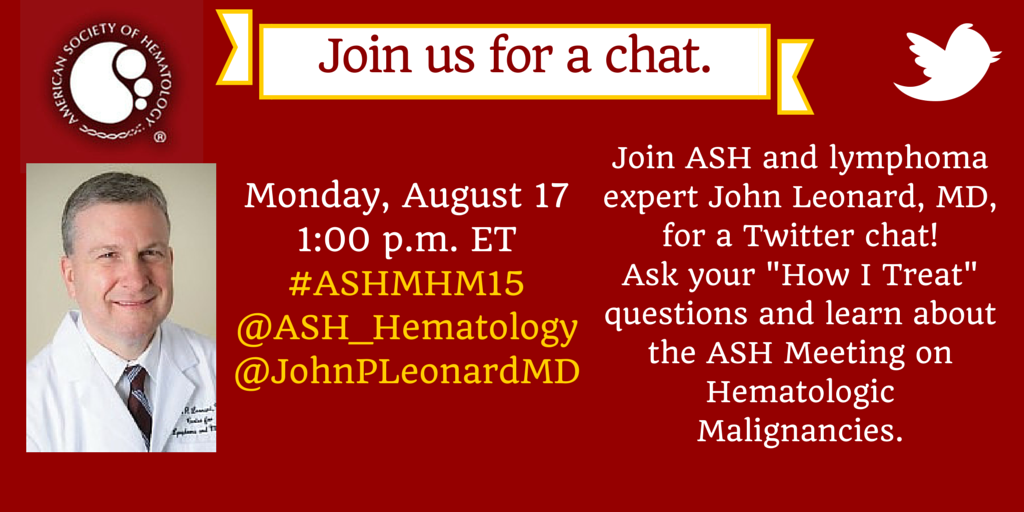
Join Dr. John Leonard for a Twitter Chat hosted by the American Society of Hematology

Leonard Twitter Chat

Research on End of Life Care and the Implication for Lymphoma Patients

Picture1By Peter Martin, MD

Most people with incurable cancer eventually face decisions about whether to continue with chemotherapy. In a recent JAMA Oncology publication, Dr. Holly Prigerson, director of the Center for Research on End of Life Care at Weill Cornell Medical College, evaluated the association between chemotherapy use and quality of life in people with progressive, metastatic solid tumors. Contrary to guidelines, which suggest that palliative chemotherapy should be considered in solid tumor patients with good performance status, Dr. Prigerson’s group found no association between chemotherapy use and survival. Moreover, chemotherapy use was associated with reduced quality of life in people that started out with a good performance status.

Although Dr. Prigerson’s study focused primarily on solid tumors like lung cancer, colon cancer, and breast cancer, some important parallels exist in the lymphoma world. While most aggressive lymphomas are initially treated with curative intent, multiple studies have demonstrated that people with aggressive lymphomas that have not responded to two prior lines of chemotherapy may not benefit from further chemotherapy. To some degree, this is intuitive. If chemotherapy has already failed twice, why would it be successful on the third attempt? Similar to Dr. Prigerson’s findings, chemotherapy in the setting of chemo-refractory lymphoma may serve only to negatively impact quality of life.

Fortunately, our understanding of lymphoma biology has expanded rapidly in the recent past, and non-chemotherapy treatments are already in the clinic with others on the way. Investigators around the world, including at Weill Cornell Medical College, are leading the development of exciting, rational approaches that might circumvent chemotherapy resistance and offer new hope, often with lesser side effects than chemotherapy. Please talk with your doctor about clinical trials, or call us at 212-746-2919  to discuss new approaches available at WCMC.