Ofatumumab Approved for Use in Combination with Fludarabine and Cyclophosphamide to Treat Patients with Relapsed CLL

The Backstory

Last month, the FDA approved the use of ofatumumab in combination with fludarabine and cyclophosphamide to treat patients with relapsed chronic lymphocytic leukemia (CLL).

This is the 4th FDA approval received by ofatumumab for the treatment of patients with CLL. Ofatumumab was initially approved in 2009 for the treatment of patients with CLL who are refractory to fludarabine and alemtuzumab, and subsequently approved in April 2014 for use in combination with chlorambucil for previously untreated patients with CLL. In January 2016 ofatumumab was approved for the treatment of patients with recurrent or progressive chronic lymphocytic leukemia (CLL) who are in complete or partial response following at least two prior treatment therapies.

What is ofatumumab?

Ofatumumab is a human monoclonal antibody designed to target the CD20 molecules found on the surface of CLL cells and B-cell lymphocytes. CD20 molecules are found in over 90% of B-cell lymphomas. Ofatumumab is an immunotherapy that works by attaching itself to the CD20 molecule found on the surface of B-cells and directs the immune system to kill the cancerous B-cells.

Why was ofatumumab granted FDA approval?

The latest approval for ofatumumab was based on improved progression free survival (PFS) results in the phase III COMPLEMENT-2 study. PFS refers to the length of time following the course of treatment, that a patient’s disease does not get worse, or progress. In this study the median PFS of ofatumumab combined with chemotherapy was 28.9 months compared to 18.8 months for only the fludarabine and cyclophosphamide combination.

Were there any side effects?

Side effects were similar to the side effects found in previous trials. They included infusion reactions, neutropenia, thrombocytopenia, anemia, nausea, leukopenia, vomiting, pyrexia, rash, fatigue, and pneumonia.

How can you access ofatumumab now?

While all available WCM trials with ofatumumab for people with CLL have recently closed, our understanding of how best to use ofatumumab continues to increase. You can look to this space for further updates on CLL trials examining the use of ofatumumab.

A full list of trials open at WCM for patients with CLL is available on our Joint Clinical Trials website.

Ask the Expert: The Difference Between CLL Stage and SLL Stage

Question

What is the difference between CLL stage (Rai or Binet) and SLL stage (Ann Arbor)? Why does the same disease have two different staging systems?

Answer

Dr. Richard Furman, M.D.

Dr. Richard Furman writes: The purpose of a staging system is to help clinicians better determine prognosis and plan treatment for a patient’s disease. Although chronic lymphocytic leukemia (CLL) and small lymphocytic lymphoma (SLL) are the same disease, they were not recognized as the same disease until 1994. Since then they have been combined into one entity, CLL/SLL.

For historical reasons, CLL was staged based upon the Rai or Binet scheme (see below) and SLL was staged using the Ann Arbor lymphoma staging scheme (see below). Today most CLL specialists use the Rai stage because it is more clinically helpful. Using the Ann Arbor classification to stage SLL is problematic in scenarios where the disease has spread to the bone marrow. A person with SLL in their lymph nodes and bone marrow would immediately be characterized as an Ann Arbor stage IV, but their prognosis and treatment plan would be far better indicated as measured by the Rai stage I. Therefore the Rai stage, even without lymphocytosis, provides better prognostic and therapeutic information for a physician to treat their patient.

Rai Stages

0: lymphocytosis (an increase in number of lymphocytes in the blood).

I: Lymphocytosis + lymphadenopathy, (enlarged lymph nodes).

II: Lymphocytosis + splenomegaly (enlargement of the spleen) +/- lymphadenopathy

III: Lymphocytosis + anemia (decrease in red blood cells) +/- splenomegaly +/- lymphadenopathy

IV: Lymphocytosis + thrombocytopenia (decrease in platelets) +/- anemia +/- splenomegaly +/- lymphadenopathy

Ann Arbor Stages

I: Disease found in one group of lymph node

II: Disease found in two or more groups of lymph nodes on the same side of the diaphragm.

III: Disease found in two or more groups lymph nodes on both sides of the diaphragm.

IV: Extranodal disease (found outside of the lymph nodes), including bone marrow, liver, or other organs)

Note: if only one isolated area or organ involvement is present, then it would be a stage I, except for bone marrow.

Taking a Pie in the Face for Lymphoma

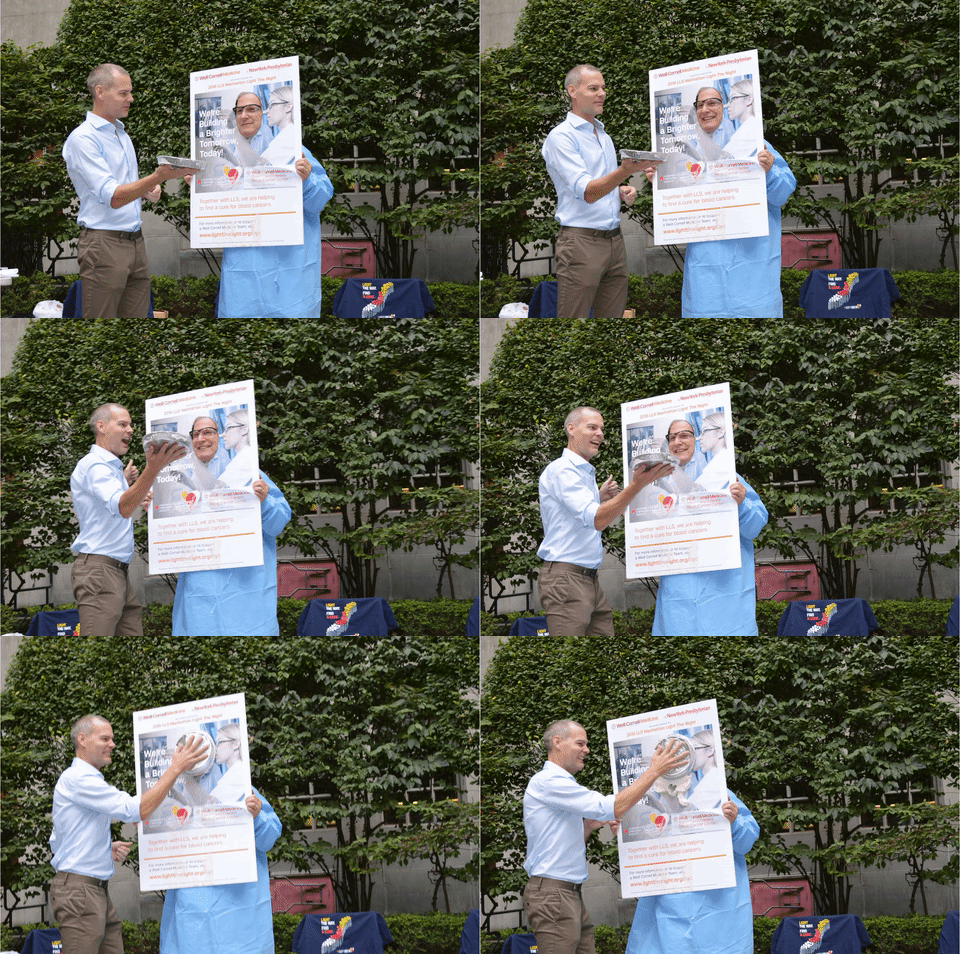
The results are in and the first annual Pie-in-the-face event was a smashing success! We raised $3500 for the  The Leukemia and Lymphoma Society as part of the 2016 Light The Night campaign.

Obviously the highlight of the event was Lymphoma Program Director, Dr. John Leonard receiving a pie in the face from his esteemed colleague Dr. Peter Martin. Look at that fakeout!

Asked about his pie throwing heroics after the event Dr. Martin said, “Sometimes this job requires us to make tough decisions, like should I throw the pie with my left hand or right hand? At first I was nervous about throwing a pie at my boss…just kidding, it was awesome.”

http://gph.is/2cRTvNNgiphy

More pics of the event can be found here. Thanks to the Meyer Cancer Center & Englander Institute for Precision Medicine for organizing this event. Additional donations can be made on our Light the Night team page.