2016 Update in Lymphoma and Myeloma: A Collaboration Across the Americas

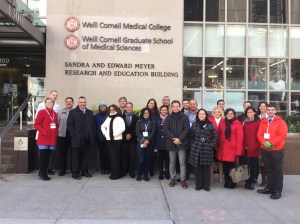
April Group Photo
Group photo of conference attendees.

Earlier this month Lymphoma Program clinical and research faculty hosted the 2016 Update in Lymphoma and Myeloma. The program is an interactive series including some didactic lectures on new data, discussion around challenging cases in the new era of targeted lymphoma therapies, and tours of our research labs to help stimulate opportunities for collaboration with a group of Latin American oncologists.

Organized by Dr. Peter Martin the meeting seeks to share experiences in managing complicated lymphomas from oncologists around the world and to form collaborative experiences that may be of mutual benefit to both the series hosts and attendees. During this year’s meeting 25 oncologists from South and Central America flew to New York City to attend. The ultimate goal is to help foster collaboration that will help to improve outcomes for patients all over the world.

Discussing the purpose of the event Dr. Peter Martin said, “We are holding this conference because lymphoma has no borders. Through our work we have developed contacts around the world and we have the opportunity to share our experiences with them to better improve patient care. We hope that they can benefit from our knowledge and experience, and help their patients. We hope to find ways to work with them to gather data and information on patient experiences in other countries, so we can help develop programs that might improve outcomes for all patients.”

Weill Cornell Lymphoma Program Study on Mantle Cell Lymphoma Has Received a Top 10 Clinical Research Forum Achievement Award from a National Clinical Research Organization

Dr. Jia Ruan examines study participant Russell Meyer. Photo credit: Carlos Rene Perez

Dr. Jia Ruan, lead author of the New England Journal of Medicine  study “Lenalidomide plus Rituximab as Initial Treatment for Mantle-Cell Lymphoma,” was in Washington on April 12 at the Clinical Research Forum fifth annual awards ceremony to receive the Top 10 Clinical Research Achievements Award.  She also presented the study at the opening plenary session during the 2016 Translational Science meeting.

The 10 winning papers were chosen based on their degree of innovation from a pool of more than 40 nominations from 30 research and academic health centers nationwide.

The multi-center phase 2 study showed that a combination therapy lacking many of the typical debilitating effects of traditional cancer treatment could effectively manage mantle cell lymphoma by inducing remissions in the vast majority of patients.

Mantle cell lymphoma (MCL) is a subtype of non-Hodgkin lymphoma that primarily affects elderly individuals. Initial treatment is not standardized and variable, but usually includes chemotherapy regimens that are generally not curative and may not be tolerated by all patients.

In this ongoing study, treatment with biologic combination of lenalidomide and rituximab led to high response rates and durable remissions in patients with previously untreated MCL, providing an effective alternative to conventional chemotherapy for a broad range of patients.

Thirty-eight patients have been treated on the study with induction and maintenance therapy. Among 36 evaluable patients, 92% responded to treatment, 64% of whom achieved complete response. Eighty-five percent of patients have no evidence of disease progression, and 97% remain alive at the two-year mark. The majority of patients reported a high quality of life as measured by quality-of-life instruments throughout treatment. The most common side effect were asymptomatic low white blood cell counts and transient inflammatory symptoms generally reversible with lenalidomide dose adjustment and supportive care.

“With this frontline treatment, we were able to achieve a very high quality and durable response rate without needing to use chemotherapy,” Ruan said. “It’s very meaningful for the patients who have always been told that their disease is without a cure.”

She thanked all of the patients who participated in the trial, as well as her Weill Cornell Medicine co-investigators: John Leonard M.D., Peter Martin M.D., Morton Coleman M.D., Richard Furman M.D., Paul Christos Dr.P.H. M.S., Orel Katz P.A., Jessica Katz P.A., and Amelyn Rodriguez R.N. Additional collaborators included Dr. Bijal Shah from Moffit Cancer Center, Drs. Steven Schuster and Jakub Svoboda from the University of Pennsylvania Abramson Cancer Center, and Dr. Sonali Smith from the University of Chicago Medical Center.


Venetoclax Approved by FDA for the Treatment of CLL Patients with 17p Deletion

The Backstory

On April 11, 2016 the FDA approved venetoclax (Venclexta) for the treatment of patients with chronic lymphocytic leukemia (CLL) with the 17p deletion who have been treated with at least one prior therapy. This is the first FDA approval for venetoclax.

In addition to this recent FDA approval, venetoclax has been granted priority review for its new drug application (NDA) of venetoclax as a single agent in CLL, as well as FDA breakthrough therapy designation for use in combination with rituximab (Rituxan) to treat patients with relapsed/refractory chronic lymphocytic leukemia (CLL).

What is venetoclax?

Venetoclax, previously known as ABT-199 is the first FDA-approved treatment that targets the B-cell lymphoma 2 (BCL-2) protein. The BCL-2 protein plays an important role in enabling CLL cells to survive. CLL cells and other lymphomas overexpress and are more dependent upon BCL-2 protein than normal cells. Therefore, when venetoclax inhibits the protein, the CLL cells die, while the normal cells continue unharmed.

What is the 17p deletion and how does it affect CLL?

17p deletion occurs  when part of chromosome 17 in the CLL cells is deleted in the CLL cells. This abnormality only occurs in the CLL cells, and not normal cells, and results in losing the p53 protein. The p53 protein plays an important role in enabling a cell to undergo suicide, and prevent itself from growing out of control. In CLL cells with a 17p deletion, the second genetic copy is often mutated, and as a result, these cells can grow more aggressively and are less responsive to chemotherapy. This results in worse clinical outcomes. Agents like venetoclax work independent of p53, and therefore are still effective in these cases. The 17p deletion is found in approximately 3-7% of newly diagnosed CLL patients, but increases to 30-40% in relapsed and refractory cases.

Why was venetoclax granted FDA approval?

Venetoclax was granted FDA approval based on the results from the M13-982 trial investigating venetoclax in patients with 17p deletion who had received at least one prior therapy. Venetoclax demonstrated an overall response rate of 80%, which included 8% complete response rates. Almost three quarters of patients were free from progression at one year.

Were there any side effects?

The most worrisome side effect of venetoclax is life-threatening tumor lysis syndrome. In the initial studies, when a full dose was administered on day one, two patients died as a result of tumor lysis. Since a modified weekly ramp-up starting at 20 mg and increasing weekly to 50 mg, 100 mg, 200 mg, and finally 400 mg once daily, no cases of clinically significant tumor lysis were seen. Common, less serious side effects included low white blood cell count, diarrhea, nausea, anemia, upper respiratory tract infection, low platelet count, and fatigue. More serious side effects included pneumonia, fever, autoimmune hemolytic anemia, anemia, and tumor lysis syndrome.

How can you access venetoclax now?

Venetoclax is commercially available. Clinical trials investigating the use of venetoclax in patients who are progressed after B-cell receptor (BCR) inhibitors, namely ibrutinib and idelalisib, are ongoing.