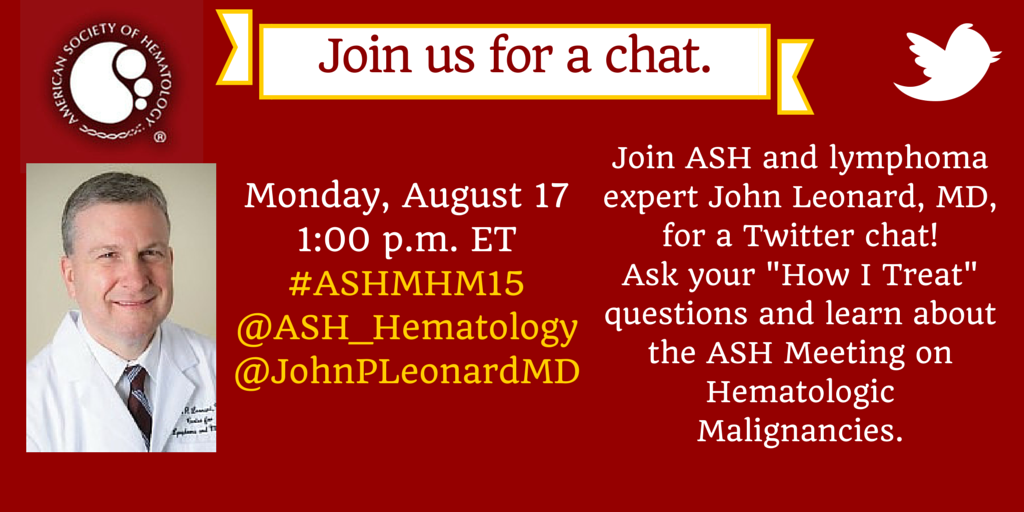
Join Dr. John Leonard for a Twitter Chat hosted by the American Society of Hematology

A Blog from the Lymphoma Program at Weill Cornell Medicine and NewYork-Presbyterian
The Weill Cornell Lymphoma Program has recently opened a new clinical trial for men and women with relapsed or refractory CLL/SLL. The study sponsor is the Celegene Corporation, and the principal investigator at Weill Cornell is Richard Furman M.D.. For more information about the study, please call Amelyn Rodgriguez, RN at (212) 746-1362 or e-mail Amelyn at amr2017@med.cornell.edu.
Key Eligibility
Study Summary
This clinical trial is for men and women with relapsed/refractory CLL/SLL.
Subjects on this study will receive the study drug, CC-122, in combination with rituximab or ibrutinib, or as a single agent. CC-122 is an analog of thalidomide and has multiple activities in CLL, including immune modulation (activation of cells in the immune system) and anti-proliferative activity. CC-122 has also been shown to have a tolerable safety profile with some preliminary signs of efficacy with early human experience. Rituximab is a monoclonal antibody directed against a molecule present on the surface of normal B lymphocytes and CLL cells. Ibrutinib is a BTK inhibitor that has received accelerated approval in the United States for patients with CLL who have received at least one prior therapy. This study will provide more information about the efficacy and safety of CC-122 both as a single agent and in combination with rituximab or ibrutinib in subjects with CLL/SLL.
All subjects will receive CC-122 continuously throughout the study as long as they are responding to therapy and not experiencing unacceptable side effects. Some subjects will receive ibrutinib which will be taken continuously throughout the study. Both CC-122 and ibrutinib will be administered orally once daily. Other subjects will receive rituximab which will be administered intravenously on cycle 1 day 1 and 8, and on day 1 of cycle 3, 5, 7, 9, and 11. After discontinuing treatment, subjects will be contacted every 90 days for follow-up information until disease progression, withdrawal of consent, or loss to follow-up.
Subjects may receive up to forty dollars per visit for the reimbursement of travel expenses.
Most people with incurable cancer eventually face decisions about whether to continue with chemotherapy. In a recent JAMA Oncology publication, Dr. Holly Prigerson, director of the Center for Research on End of Life Care at Weill Cornell Medical College, evaluated the association between chemotherapy use and quality of life in people with progressive, metastatic solid tumors. Contrary to guidelines, which suggest that palliative chemotherapy should be considered in solid tumor patients with good performance status, Dr. Prigerson’s group found no association between chemotherapy use and survival. Moreover, chemotherapy use was associated with reduced quality of life in people that started out with a good performance status.
Although Dr. Prigerson’s study focused primarily on solid tumors like lung cancer, colon cancer, and breast cancer, some important parallels exist in the lymphoma world. While most aggressive lymphomas are initially treated with curative intent, multiple studies have demonstrated that people with aggressive lymphomas that have not responded to two prior lines of chemotherapy may not benefit from further chemotherapy. To some degree, this is intuitive. If chemotherapy has already failed twice, why would it be successful on the third attempt? Similar to Dr. Prigerson’s findings, chemotherapy in the setting of chemo-refractory lymphoma may serve only to negatively impact quality of life.
Fortunately, our understanding of lymphoma biology has expanded rapidly in the recent past, and non-chemotherapy treatments are already in the clinic with others on the way. Investigators around the world, including at Weill Cornell Medical College, are leading the development of exciting, rational approaches that might circumvent chemotherapy resistance and offer new hope, often with lesser side effects than chemotherapy. Please talk with your doctor about clinical trials, or call us at 212-746-2919 to discuss new approaches available at WCMC.

 New Developments in Lymphoma