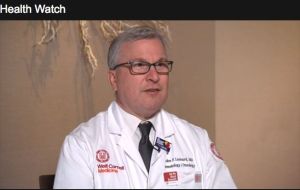
Last week, Dr. Leonard held a lecture to discuss how lymphoma medicine is precision medicine. Precision medicine treatment options are tailored to each patient’s specific genetic profile and medical history. With the availability of genomic sequencing tools, it is now feasible to profile a patient’s genome and locate the mutations that cause cancer.
Dr. John Leonard
Each year more than 80,000 cases of lymphoma are reported, spanning over 100 different classifications. The majority of these are non-Hodgkin lymphomas. The most common forms of which are follicular lymphoma, diffuse large B-cell lymphoma (DLBCL), chronic lymphocytic lymphoma, and mantle cell lymphoma. Although these are all subtypes of the same disease, the variances in their biology require different treatment approaches.
To illustrate the effectiveness of precision medicine approaches in lymphoma, Dr. Leonard cited the treatment of DLBCL. For patients with DLBCL, the standard initial treatments are the chemotherapy combination R-CHOP and dose adjusted R-EPOCH. Around 70% of cases are cured with either of these two treatments, proving that chemotherapy is effective.
The other 30% of patients who do not respond to treatment proceed to 2nd and 3rd lines of therapy. For patients whose DLBCL returns, there is only a 20% survival rate. This low survival rate for patients with recurrent lymphoma and patients who do not respond to chemotherapy necessitates different approaches to treatment. This is not an abandonment of effective chemotherapy, but a way to tailor treatment more specifically to the patient’s individual tumor biology.
Precision medicine in lymphoma treatment involves targeting the “cancer cell-of-origin” in patients, or in other words, the genetic source of the cancer. Through gene expression profiling, we are able to determine distinct molecular subtypes. This could allow us to detect malignancies earlier on and offer better preventative treatment for individuals at risk of developing blood cancer. Continued advances in our understanding of the genome fuels the growth of precision medicine which already plays an important role in treating certain lymphomas.
Although precision medicine is a huge advancement for the treatment of lymphoma, there are still challenges. This includes weighing the effectiveness of drugs used in targeted therapy, developing tools to categorize the different lymphoma subtypes, cost, and patient participation. Because it is a still a growing field, many precision medicine goals are still in the early stages of development.



 New Developments in Lymphoma