
The FDA Approval Process: A Primer

Peter Martin, M.D.

By Peter Martin, M.D.

In addition to providing the best possible care for people with lymphoma, one of our primary goals in the Weill Cornell Lymphoma Program is to help develop better treatments. To keep track of these approvals we have created the Lymphoma Therapy Approval Timeline page on our blog. The timelines lists all of the new Breakthrough Designations, and approvals generated by the FDA for therapies related to the treatment of lymphoma. More in-depth information about these approvals can be found  our blog.

So far, 2016 has been an eventful year, with six drugs receiving an updated approval status or Breakthrough Therapy Designation for the treatment of lymphoma. At the same time, recent circumstances have led to the closure of at least seven clinical trials evaluating the role of idelalisib. In the face of all this activity, it is clear that we are keeping the FDA busy. People in my clinic ask me almost every day, “Why does it take the FDA so long to approve promising new drugs?” To help answer this question I will write a series of blog posts summarizing the drug development process. An in-depth explanation of the process can be found on the FDA website.

Today, in the first post of the series, I thought it would be interesting to address whether the FDA is a bureaucratic wall standing between patients and potentially lifesaving cancer therapy, whether the FDA has become too lax in its approval process, resulting in approval of dangerous drugs or labels that are too broad, or whether it gets the balance just right.

In 2014 Yale University researchers published a study that sought to characterize how new treatments were approved by the FDA between 2005 and 2012. Of the 188 new treatments included in the study the largest group were cancer treatments at 41 (19.9%). Compared to other indications, cancer treatments were more frequently approved through less time consuming non-randomized, non-blinded studies, and accelerated approval programs. Instead of using standard clinical outcomes, nearly all of these trials measured surrogate end points like reduced tumor size or decreased biomarker levels. These endpoints can be reached in shorter periods of time than clinical outcomes like overall survival. The study authors noted that while treatments for other indications generally relied on 3 trials, “Most therapeutic agents approved for cancer indications were approved on the basis of a single trial.”

Some of these recent approvals likely reflect that fact that we are in the midst of a scientific revolution, with an explosion of new drugs that are clearly superior to older therapies becoming available at an unprecedented rate. But it is also clear that the FDA is aware that people with cancer face unique circumstances and are willing to move forward with new drugs at a faster rate. If you have any specific questions or experiences that you’d like us to cover in this series of posts, let me know and I’ll do my best to address them. Stay tuned!
Pembrolizumab Granted FDA Breakthrough Therapy Designation for Relapsed/Refractory Classical Non-Hodgkin Lymphoma

The Backstory

On April 18 the FDA granted the immunotherapy pembrolizumab (Keytruda) the Breakthrough Therapy Designation for the treatment of patients with relapsed or refractory classical Hodgkin lymphoma (cHL). The Breakthrough Therapy Designation indicates that the FDA perceives the drug candidate may represent a substantial improvement over existing therapies and that it warrants additional resources to help expedite the approval process.

What is pembrolizumab?

Pembrolizumab is a humanized monoclonal antibody that binds to programmed death receptor-1 (PD-1). PD-1, also called programmed cell death protein-1, binds to programmed death ligand-1 (PD-L1), initiating inhibitory, immunosuppressive signals in T cells. Tumor cells, like Hodgkin lymphoma cells, often take advantage of this PD-1 by increasing expression of PD-L1, turning off the T cells and helping them to evade a potentially damaging immune response. Pembrolizumab acts by binding to PD-1, blocking its inhibitory actions, thereby activating the T-cell response against cancer cells, and initiating cell death.  Pembrolizumab is already approved by the FDA for treatment of patients with unselectable or metastatic melanoma and for patients with non-small cell lung cancer whose tumors express PD-L1.

Why did the FDA grant pembrolizumab a Breakthrough Therapy Designation?

The new designation is based on preliminary date from the KEYNOTE-013 trial, which was last presented at the 2015 meeting of the American Society of Hematology, and the KEYNOTE-087 trial. In KEYNOTE-013, 64% of patients with brentuximab vedotin-refractory cHL responded, including 16% achieving a complete response. Results from the KEYNOTE-087 trial are not yet public but will likely be presented soon.

Were there any side effects?

Side effects were considered manageable and the most common included hypothyroidism, diarrhea, nausea, and pneumonitis.

How can you access pembrolizumab now?

Although the FDA has approved pembrolizumab for melanoma and lung cancer, it has not yet approved pembrolizumab for Hodgkin lymphoma. Patients interested in receiving immune checkpoint inhibitors are advised to seek out clinical trial options. Please visit our clinical trials website or contact our office (646-962-2064) for additional information.

2016 Update in Lymphoma and Myeloma: A Collaboration Across the Americas

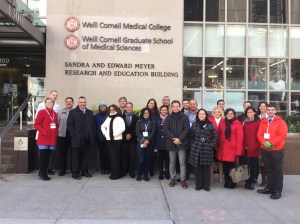
April Group Photo
Group photo of conference attendees.

Earlier this month Lymphoma Program clinical and research faculty hosted the 2016 Update in Lymphoma and Myeloma. The program is an interactive series including some didactic lectures on new data, discussion around challenging cases in the new era of targeted lymphoma therapies, and tours of our research labs to help stimulate opportunities for collaboration with a group of Latin American oncologists.

Organized by Dr. Peter Martin the meeting seeks to share experiences in managing complicated lymphomas from oncologists around the world and to form collaborative experiences that may be of mutual benefit to both the series hosts and attendees. During this year’s meeting 25 oncologists from South and Central America flew to New York City to attend. The ultimate goal is to help foster collaboration that will help to improve outcomes for patients all over the world.

Discussing the purpose of the event Dr. Peter Martin said, “We are holding this conference because lymphoma has no borders. Through our work we have developed contacts around the world and we have the opportunity to share our experiences with them to better improve patient care. We hope that they can benefit from our knowledge and experience, and help their patients. We hope to find ways to work with them to gather data and information on patient experiences in other countries, so we can help develop programs that might improve outcomes for all patients.”