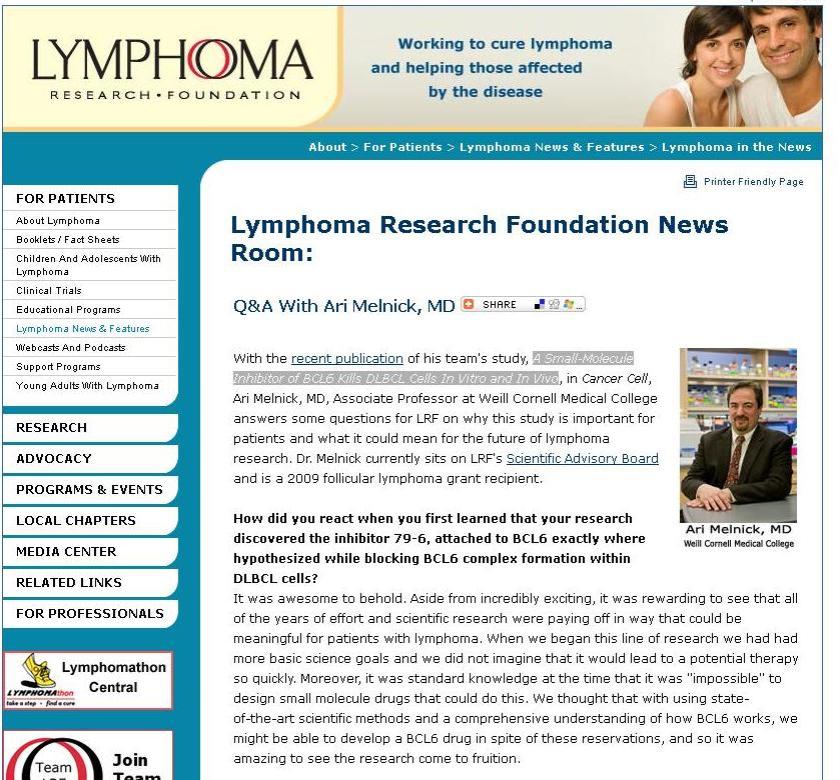
Weill Cornell’s Dr. Ari Melnick on BCL6 Inhibitor Research: Implications for Lymphoma Research

Ari Melnick, MD, director of the Melnick Lab at Weill Cornell Medical College, was interviewed by the Lymphoma Research Foundation about his breakthrough research on a BCL6 inhibitor. Dr. Melnick discusses why this study is important for patients and what it could mean for the future of lymphoma research.

Click on the image below to read the Q&A.

Vitamin D and Lymphoma

By Rebecca Elstrom, MD

Vitamin D has recently received an enormous amount of attention as the realization that many Americans are deficient in vitamin D intersects with new data regarding the possible role vitamin D may play in regulation of cancer development. A frequent question from my patients has become, “Should I be taking vitamin D?”

Last year, a group of researchers from the Mayo Clinic reported that patients with lymphoma who are vitamin D deficient had a poorer chance of surviving their disease. This was a correlative study; it did not explore whether vitamin D deficiency actually caused the patients to respond more poorly to therapy. While it is possible that vitamin D played a causative role, it is equally feasible that vitamin D deficiency was a marker for patients who were sicker for other reasons, and therefore less likely to tolerate or to respond well to treatment. Further studies will be necessary to clarify whether vitamin D deficiency caused patients to do worse, and therefore whether supplementing vitamin D in patients who are deficient will lead to better outcomes.

Until these further studies are done, what should we do? There is no indication that having higher than normal vitamin D levels will be better than having normal levels; therefore, there is not a rationale for patients with normal levels to supplement vitamin D. However, for patients who are vitamin D deficient, it seems reasonable to supplement it to normal levels, whether it will directly impact lymphoma treatment results or not. A related question is whether every patient with lymphoma should be screened for vitamin D deficiency. Until the direct impact on lymphoma outcome is clear, I cannot recommend mass screening, but discussion between patient and provider is appropriate regarding this intriguing finding.

Weill Cornell Research: Epigenetic Priming to Improve Chemotherapy Response Can Be Safely Administered in AML Patients

By Rebecca Elstrom, MD

Researchers at Weill Cornell Medical Center have demonstrated that epigenetic priming of standard induction chemotherapy can be safely administered in an attempt to improve the response rate of patients with acute myeloid leukemia (AML).

Epigenetics refers to reversible alterations to DNA or DNA-associated proteins which affect gene expression, and epigenetic processes have been shown by researchers at WCMC and others to be disrupted in many types of cancer.  Drugs currently available and approved by the FDA can target these abnormal epigenetic changes, and pretreatment with these drugs (epigenetic priming) might make cancer cells more vulnerable to chemotherapy.

In the research study recently published in Blood, the Journal of the of the American Society of Hematology, patients were treated with the drug decitabine prior to a standard induction of chemotherapy. The toxicity, or side effects, of chemotherapy plus decitabine was similar to that of chemotherapy alone. Although the primary purpose of the study was to evaluate the safety of adding decitabine, the epigenetic primer, to standard chemotherapy, the overall complete response rate was 83%, suggesting that decitabine-primed induction should be explored as a complementary approach to standard chemotherapy. Click here to read the published research paper.

There is the possibility that the approach of epigenetic priming could translate into therapeutic advantages in other forms of cancers.  Many types of cancers have been shown to develop with abnormal epigenetic changes, including lymphoma.  The lymphoma research group at Weill Cornell Medical Center is  also exploring the strategy of epigenetic priming in patients with newly diagnosed aggressive B cell  non-Hodgkin’s lymphoma, in hopes of improving on results of standard chemotherapy. Click here to read more about this study. Click here to read the clinical and research profile of Rebecca Elstrom, MD, the physician leading the lymphoma trial.