
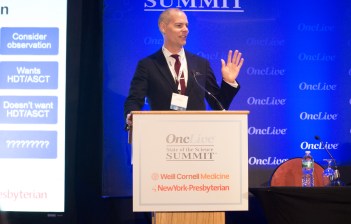
 Citing a pattern of intensive mantle cell lymphoma (MCL) treatment regimens, Dr. Peter Martin – who co-chaired the OncLive State of the Science Summit on May 4, 2017, along with Dr. John Leonard – proposed that physician-researchers become more mindful of patient preferences when determining treatment regimens. He noted that some patients might prefer to receive more broadly accessible treatments and that those decisions may not significantly impact outcomes.
High-dose cytarabine followed by an autologous stem cell transplant, for example, is an effective treatment regimen for patients with MCL, at times inducing remission durations of 10 years. But people with MCL, who tend to be in their mid-sixties, are rarely keen to take the requisite six months away from work in order to receive treatment. Because fewer than 25 percent of MCL patients are eligible for intensive regimens, more practical treatment strategies are needed.
Dr. Martin also stressed the need to find a way to help patients who are destined to have poorer outcomes due to the presence of multiple risk factors as defined in the combined Mantle Cell Lymphoma International Prognostic Index (MIPIc). These factors include: age, white blood cell count, performance status, lactate dehydrogenase (LDH), and Ki67, a marker of tumor cell proliferation.
In a comparison of two clinical trials from the European Mantle Cell Lymphoma Network, one in which patients less than 65 years of age were treated intensively with an autologous stem cell transplant, and another wherein a set of older patients received R-CHOP or fludarabine-based therapy followed by rituximab maintenance, Dr. Martin pointed out that patients with similar MIPIc scores had similar outcomes no matter their treatment regimen.
Dr. Martin highlighted that multiple clinical trials are underway to determine the best drug to combine with the MCL treatment backbone of bendamustine rituximab, to investigate ibrutinib combinations in the relapsed setting, and to evaluate the necessity of intensive treatments like stem cell transplantation.
Watch this OncLive clip for more of Dr. Martin’s thoughts on patient preference:

 New Developments in Lymphoma