New Clinical Trial: GS-1101 in Combination with Bendamustine and Rituximab for Previously Treated CLL

Update: this study is closed to enrollment. 

The Weill Cornell Lymphoma Program is now recruiting men and women with previously treated, recurrent chronic lymphocytic leukemia (CLL) for a clinical trial evaluating the experimental drug GS-1101 (also called Idelalisib, formerly called CAL-101), combined with bendamustine and rituximab, in treating CLL. The study sponsor is Gilead Sciences, Inc, and the principal investigator at Weill Cornell is Dr. Richard Furman. For more information about the study, please call Amelyn Rodgriguez, RN at (212) 746-1362 or e-mail Amelyn at amr2017@med.cornell.edu.

Key Eligibility
  • Age 18 and older
  • Diagnosis of B-cell chronic lymphocytic leukemia (CLL)
  • Previously treated for CLL
  • Detailed eligibility reviewed when you contact the study team
Study Details

GS-1101 (CAL-101) is a pill designed to block some of the cell functions that cause CLL to grow and survive and may help control the disease. Rituximab and bendamustine are approved by the FDA as a treatment for CLL. The study will help determine whether adding GS-1101 (CAL-101) to the standard treatment of rituximab and bendamustine will have a better effect on controlling CLL.

Study participants will be randomly assigned to one of two treatment groups:

  • Group A: GS-1101 and rituximab/bendamustine
  • Group B: Rituximab/bendamustine and placebo (an inactive pill that looks like GS-1101 but contains no medicine)

After 20 weeks of therapy with rituximab, bendamustine and GS-1101 or placebo, participants will continue with GS-1101 or placebo as long as their CLL is controlled.
Clinical Trial: MLN8237 in Relapsed/Refractory Aggressive B-Cell Lymphoma Treated With Rituximab & Vincristine

Update: this study is closed to enrollment. 

The Weill Cornell Lymphoma Program has recently opened a new clinical trial for men and women with relapsed or refractory Diffuse Large B-Cell Lymphoma (DLBCL) and other aggressive lymphomas including Transformed Follicular Lymphoma, and Mantle Cell or Burkitt Lymphoma. The study sponsor is Millennium Pharmaceuticals, and the principal investigator at Weill Cornell is Dr. Jia Ruan. For more information about the study, please call Amelyn Rodgriguez, RN at (212) 746-1362 or e-mail Amelyn at amr2017@med.cornell.edu.

Key Eligibility
  • Men and women age 18 and older
  • Parts 1 and 2:
    • Diffuse Large B-Cell Lymphoma, Transformed Follicular Lymphoma, Mantle Cell or Burkitt Lymphoma
  • Part 3:
    • Diffuse Large B-Cell Lymphoma, Transformed Follicular Lymphoma (people with Mantle Cell or Burkitt Lymphoma are eligible for Parts 1 and 2 only)
    • For Part 3, must have received prior rituximab
  • Relapsed or refractory after at least 1 prior systemic treatment for aggressive lymphoma; relapsed following autologous stem cell transplant is allowed
  • Detailed eligibility reviewed when you contact the study team
Study Details

The purpose of the study is to investigate whether the experimental drug MLN8237 has any treatment benefit when combined with rituximab (this combination is called MR) or when combined with rituximab and vincristine (called MRV). The study will also evaluate the safety and tolerability of the MR and MRV combinations.   Continue reading “Clinical Trial: MLN8237 in Relapsed/Refractory Aggressive B-Cell Lymphoma Treated With Rituximab & Vincristine”

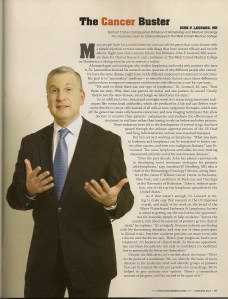
Weill Cornell’s Dr. John Leonard One of “Top 8 Leaders” in Westchester Magazine

John Leonard, MD, the Director of the Weill Cornell Lymphoma Program, is featured in Westchester Magazine’s “Top 8 Leaders in Westchester County in 2013.”

Dr. Leonard is the Richard T. Silver Distinguished Professor of Hematology and Medical Oncology and Associate Dean for Clinical Research, Weill Cornell Medical College.

Click the image below to read the article.

Westchester Magazine