The Body’s Military Defense

Lymphoma is a collective term representing over 100 different types of the disease. Disease subtyping allows clinicians to determine a more precise diagnosis for each individual patient and plan optimal treatment accordingly.

A small percentage of lymphomas in the United States are classified as Hodgkin lymphomas, with the remaining majority falling under the non-Hodgkin category. Further, approximately 90 percent of non-Hodgkin lymphomas are B-cell malignancies, versus 10 percent T-cell.

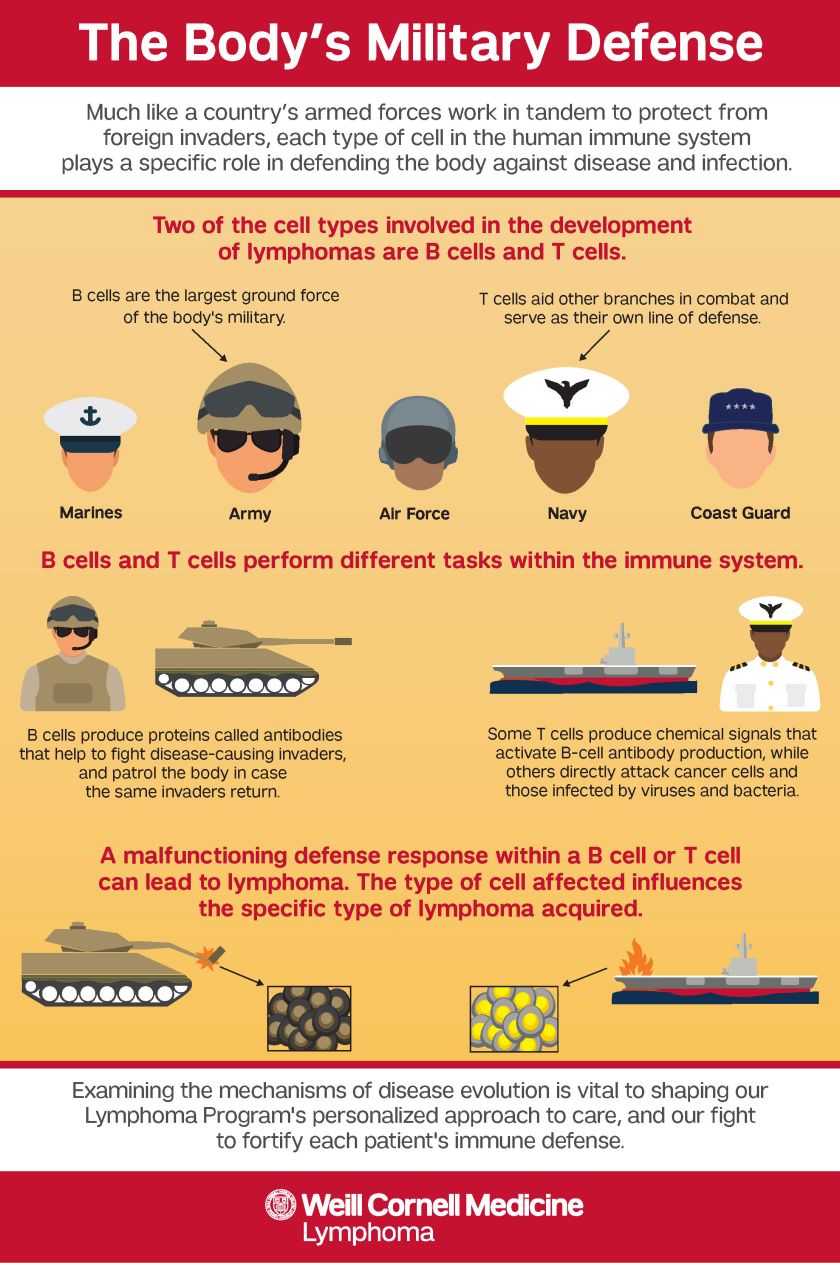
Here’s how B and T cells act like branches of the military to protect the body from disease – and what happens when these immune cells are unable to perform their jobs adequately.

The Body's Military Defense

For the origin of this analogy, check out this episode of the Leukemia and Lymphoma Society’s Bloodline podcast, featuring our own Dr. John Leonard.


2018 American Society of Hematology (ASH) Annual Meeting

The American Society of Hematology (ASH) is the world’s largest professional society serving clinicians and scientists who work to conquer blood diseases. The ASH Annual Meeting & Exposition brings together over 25,000 hematology professionals from around the world to discuss the understanding, diagnosis, treatment, and prevention of disorders affecting the blood, bone marrow, and immunologic, hemostatic and vascular systems.

This year, the ASH Meeting celebrated its 60th anniversary in San Diego, CA. As always, our team was proud to contribute new lymphoma discoveries for presentation at the meeting. Here are some research highlights from our team.


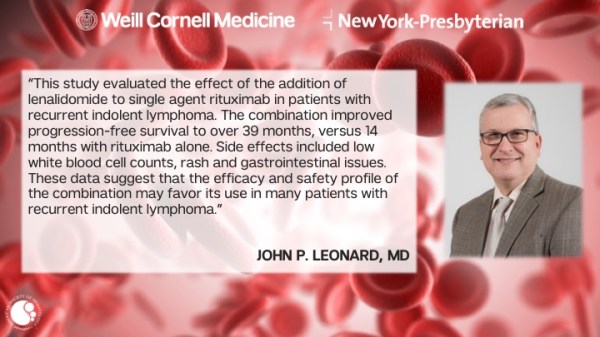
Dr. John Leonard led a global phase III clinical trial comparing the efficacy and safety of combined lenalidomide plus rituximab versus rituximab alone in people with previously treated indolent lymphoma, including follicular and marginal zone lymphoma. Results demonstrating lenalidomide-rituximab as an important new treatment option for this patient population.
Leonard


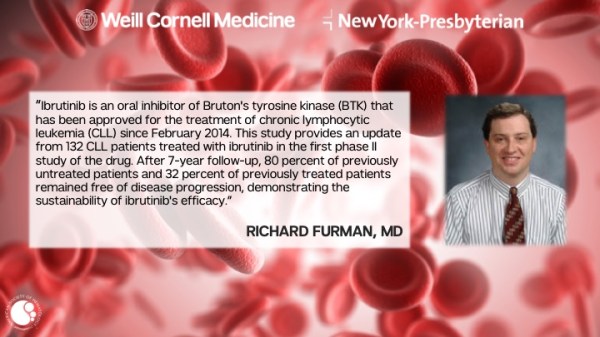
Dr. Richard Furman and colleagues found that at follow-up of up to seven years, ibrutinib demonstrated sustained activity in both first line and relapsed/refractory chronic lymphocytic leukemia (CLL) patients.
Furman2


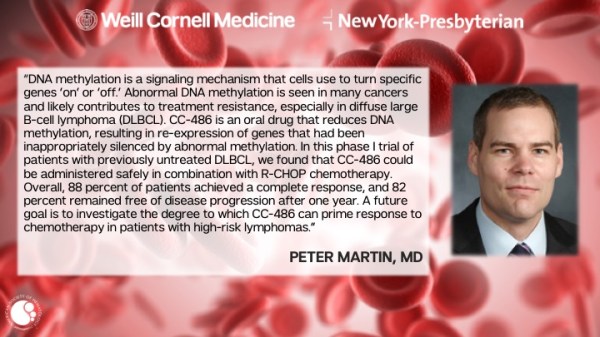
Dr. Peter Martin led a study examining the safety and efficacy of CC-486, also known as oral azacitidine, plus R-CHOP chemotherapy in people with diffuse large B-cell lymphoma (DLBCL).
Martin.jpg


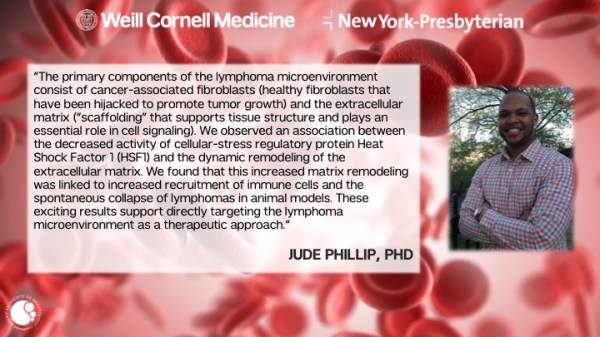
Using a combination of human, animal, and cell line data, Jude Phillip, PhD, of the Leandro Cerchietti Research Lab, and colleagues found that the internal architecture of lymphomas present important insights into disease progression.
Phillip.jpg


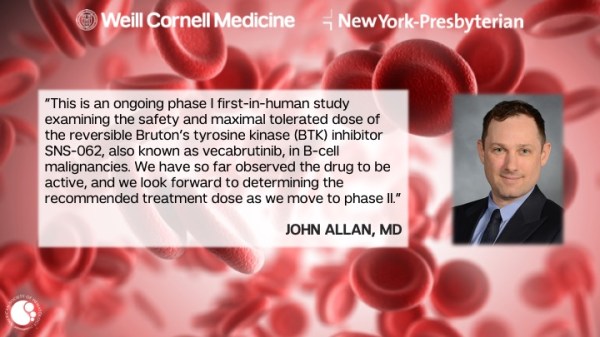
Dr. John Allan presented a preliminary update of an ongoing first-in-human study of vecabrutinib in patients with advanced B-cell malignancies.
Allan.jpg


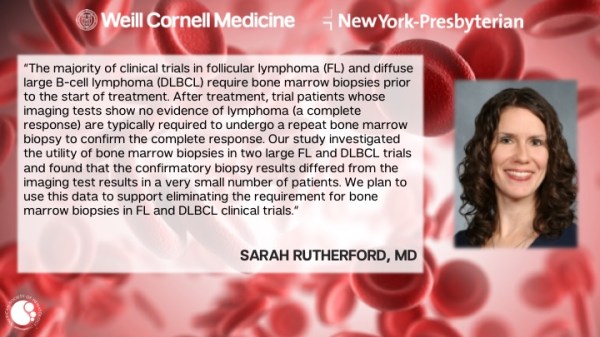
Dr. Sarah Rutherford reported data that may support the elimination of bone marrow biopsies in follicular lymphoma and diffuse large B-cell lymphoma clinical trials.
Rutherford.jpg


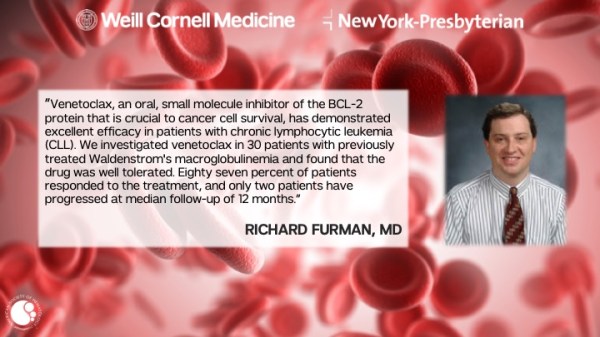
Dr. Richard Furman and colleagues found that venetoclax is well tolerated and produces high levels of response in previously treated Waldenstrom’s macroglobulinemia patients.
Furman1


We are proud of our team’s continued commitment to advancing the overall understanding of lymphoma and improving clinical outcomes and quality of life for all those affected by the disease.

New Treatment Combination Poses Potential Way to Combat Chemo-Resistant DLBCL

Each year, roughly 20,000 Americans are diagnosed with diffuse large B-cell lymphoma (DLBCL), an aggressive cancer of abnormal B-cells. Most people with DLBCL are cured with the standard chemotherapy regimen rituximab, cyclophosphamide, doxorubicin, vincristine, and prednisone (R-CHOP), but 30-40 percent of cases are resistant to chemotherapy for reasons that may be related to the way that genes are regulated within the cancer cells.

Prior WCM laboratory research demonstrated that certain genes within chemotherapy-resistant DLBCL cells are often inappropriately turned off and that long-term exposure to low doses of oral hypomethylating agent azacitidine (also known as CC-486) can turn those genes back on, thereby re-sensitizing the cells to chemotherapy.

Lymphoma Program chief Dr. Peter Martin, Dr. Leandro Cerchietti, Dr. John P. Leonard, Dr. Maria Revuelta and Dr. ldefonso Ismael Rodriguez-Rivera, and colleagues from around the country, set out to test a novel therapeutic alternative for these chemo-resistant cases with a phase I, open-label, multicenter trial of oral azacitidine plus R-CHOP in people with high-risk, previously untreated DLBCL, grade 3B follicular lymphoma (FL), or transformed lymphoma. The trial was conducted in collaboration with Alliance Foundation Trials (AFT), a research organization that develops cancer clinical trials with pharmaceutical companies, scientific investigators and the Alliance for Clinical Trials in Oncology (ACTO) institutional member network.

Patients in the trial received CC-486 for seven days prior to R-CHOP initiation, then for 14 days prior to each of five following R-CHOP cycles. The research team found that the combination of CC-486 plus R-CHOP was safe and well tolerated, and that it produced a higher-than-anticipated complete response (CR) rate, or disappearance of signs of cancer, exceeding 85 percent. Dr. Cerchietti’s lab also identified key changes in genes and gene expression consistent with the anticipated CC-486 effect. Dr. Martin presented the team’s findings at the American Society of Hematology Annual Meeting and Exposition on December 9, 2017, in Atlanta, GA.

Weill Cornell Medicine

“We are at an exciting moment in time: CC-486 is emerging simultaneously with a peak in collaborative efforts between scientists, physicians and patients,” said Dr. Martin. “We are working day and night to move this concept forward, including the possible opening of randomized trials.”